For food manufacturers, the lowest-priced raisins are not always the most cost-effective choice.
When sourcing natural food ingredients, price is often the most visible and easiest factor to compare.
The same applies to raisins. Some suppliers may offer lower prices, while others may quote higher prices.
Naturally, buyers may ask: “Why should we pay more?” However, for raisins that are used in industrial food production, purchase price represents only one part of the total cost.
Once raisins enter a food manufacturing facility, they go through multiple stages, including storage, handling, production, packaging, and final product delivery.
If raw materials create issues at any stage, the initial savings from a lower purchase price can quickly be offset by additional costs.
Therefore, food manufacturers should not only consider:“How much does a ton of raisins cost?” They should also ask: “What is the real cost after these raisins enter our production system?”
A Lower Price Does Not Always Mean Lower Cost
Imagine two batches of raisins:
Supplier A: Lower purchase price
Supplier B: Higher purchase price
Based only on the quotation, Supplier A may appear to offer a better deal. However, if Supplier A’s raisins require additional handling due to issues such as:
· Insufficient foreign material control
· Large variation in particle size
· Inconsistent color between batches
· Unstable moisture characteristics
· Sugar crystallization or fruit clumping
· Higher levels of abnormal fruit
the manufacturer may need to invest additional resources in:
· Manual sorting
· Pre-processing
· Additional screening
· Production adjustments
· Quality management
In this situation, the manufacturer is no longer purchasing only “raisins”.
They are purchasing: Raisins + Additional Processing Costs + Production Risks
A lower purchase price only means spending less at the moment of purchase. It does not necessarily mean achieving a lower total cost throughout the production cycle.
The Most Expensive Cost Is Often Uncertainty
For food manufacturers, the biggest challenge is not always the price of raw materials.
It is: Not knowing what will happen with the next batch.
When raw materials perform consistently, production teams can follow established processes with confidence.
However, when raw material performance fluctuates, manufacturers may need to continuously adjust:
· Production parameters
· Ingredient handling methods
· Pre-processing procedures
· Product formulations
· Quality evaluation processes
In some cases, they may even need to deal with non-conforming products.
The challenge is that these costs rarely appear directly on a purchase order.
However, they exist throughout the entire value chain — including production, quality control, R&D, and supply chain management.
That is why food manufacturers should evaluate: The total cost of using an ingredient, not just the purchase price.
Moving from Purchase Price to Usage Value
When evaluating raisin suppliers, food manufacturers can shift the conversation from a simple question:
Traditional question: “How much do your raisins cost?”
To a more important question: “How will your raisins perform in our production process?”
And further: “Can you maintain the same performance batch after batch?”
These questions represent three different levels of evaluation.
Level 1: Price How much do we pay today?
Level 2: Performance can the raisins meet our production requirements?
Level 3: Consistency Can the same quality and performance be maintained next month, next season,and over long-term cooperation?
For food manufacturers, the second and third levels often matter more than the first one.
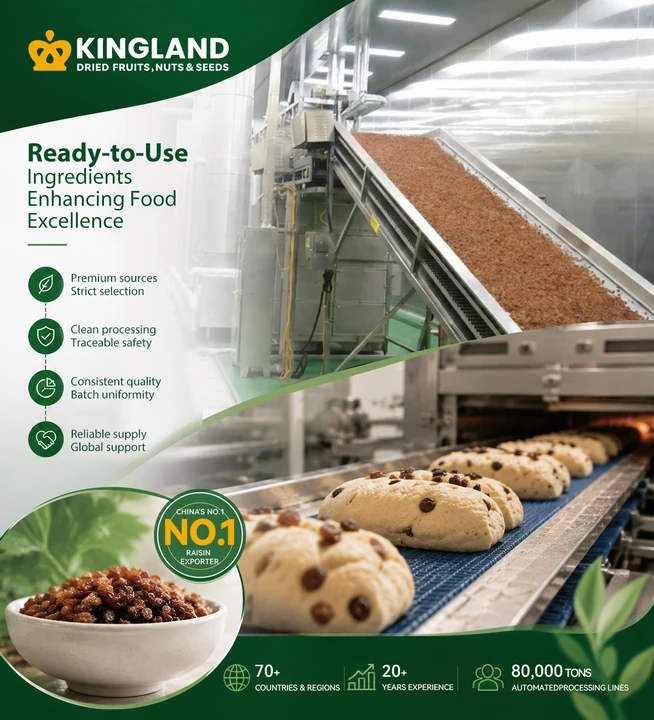
What Really Matters When Selecting Raisins?
A complete evaluation system should include more than price.
01 | Cleanliness & Food Safety
Can the raisins meet industrial food production requirements for cleanliness, safety, and quality assurance?
02 | Specifications
Are the particle size, color, variety, and format suitable for the intended application?
03 | Production Compatibility
Can the raisins perform consistently and efficiently within the manufacturer’s production system?
04 | Supply Reliability
Can stable quality and supply be maintained across different batches, seasons, and long-term cooperation?
05 | Price
Only after these factors are considered should purchase price become the final comparison point.
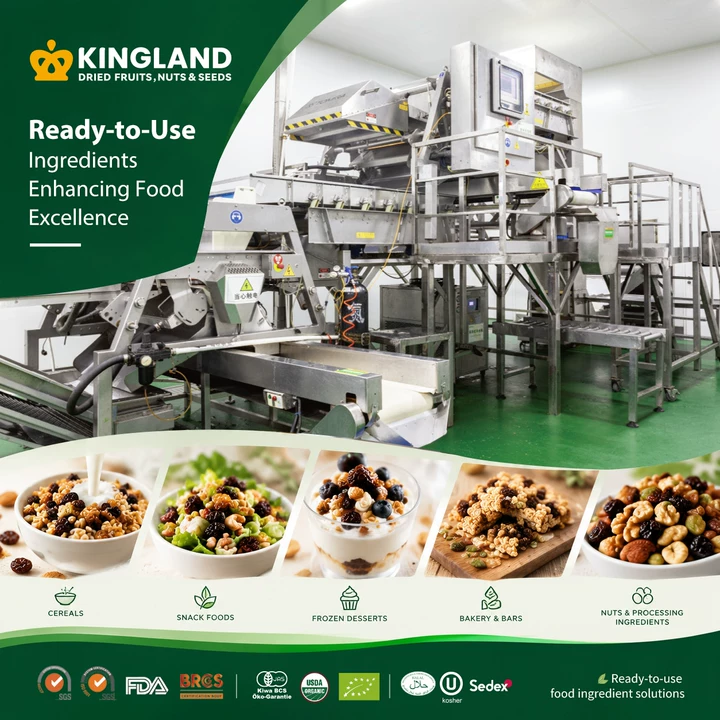
Ultimately, food manufacturers are not simply choosing:
“Who offers the lowest-priced raisins?”
They are choosing:
“Who can provide raisins that deliver more stable performance, fewer production challenges, and lower overall costs?”
This Is How KINGLAND Understands Ready-to-Use Food Ingredients
At KINGLAND, raisins are not simply considered a raw agricultural product purchased and delivered.
From raw material selection, processing, sorting, and quality control, to their final application in food manufacturing, every step influences whether the ingredient can truly perform in production.
Because we understand that food manufacturers need more than a competitive price.
They need: Consistent quality, suitable specifications, reliable food safety, and ingredients that can continuously support stable production.
This is our understanding of Ready-to-Use Food Ingredients:
Transforming natural agricultural products into food ingredients that are better prepared for industrial food applications through professional processing and quality management.
For food manufacturers, a valuable ingredient partner is not the one who simply helps reduce the purchase price.
It is the partner who helps reduce uncertainty throughout the entire production process.
Because in the food industry, the real challenge is not only controlling ingredient costs. It is controlling production risks.